The fear of getting the first attempt wrong holds people back from trying at all.
People think their first attempt is the only one they will get so they need the right idea, timing, and skills to make it perfect.
The best cure for this is assuming you will get another attempt. Even if this idea is your very best one, one you want to save to get right, I still think you should attempt it and assume you’ll try again.
There are many reasons why. Here they are:
Iterate (please)
When you iterate and try again, you reduce the pressure of an individual attempt because you prepare yourself to get another.
This might require some setup, like changing the format of your work. You need a vessel for iteration like a startup, newsletter, class, or daily habit. For example, attempting to write a book is a big task that’s hard to iterate on, but writing an essay or short story is similar and simpler.
Iteration enables you to build skills and momentum, but it’s important that you actually finish. Doing this is difficult, but it’s the way you expand your capabilities. It’s not good enough just to write, you need to publish. There are parts of the creative process only revealed by completing your attempt and every completion builds your confidence that you can do another.
You can even iterate on the same thing multiple times. The Martian was a short story, a web series, a book, and then a movie. It went through significant revisions every time. Warren Buffett acquired Rose Blumkin‘s Nebraska Furniture Mart in 1983 and she left the business six years later, at 95. Within a few months she was back, opening a rival store across the street. Buffett bought that one too.
One-hit wonders and overnight successes are fake. It’s better for you to believe they just don’t exist, and if you were one of them, you’d probably not be reading this blog. Great artists do tens, hundreds of iterations to find the right one. That is part of the process.


Find what works and do it again
There is a sort of self-sabotage people do when attempting something: they reinvent everything every time. They think every attempt needs to be completely new like it’s their first one (and all the pressure that comes along with it). They abandon the ideas, strategies, and processes of the last attempts.
Successful people don’t do this. They compound. Can you imagine if Warren Buffett was like “uhhh, this strategy of being slow, thoughtful, and compounding isn’t working fast enough, I’m going to invest in crypto.”

You need to be riffing: find something that works and come at it from different angles. For example, the best strategy I’ve seen for becoming a successful Twitter poster is basically to test lots of subjects, zero in on one that is successful, and endlessly post about that. Become “the guy” for that subject. Stick to the bit.
There’s an even more literal interpretation of this: just post the exact same thing again.
Your idea does not need to be original
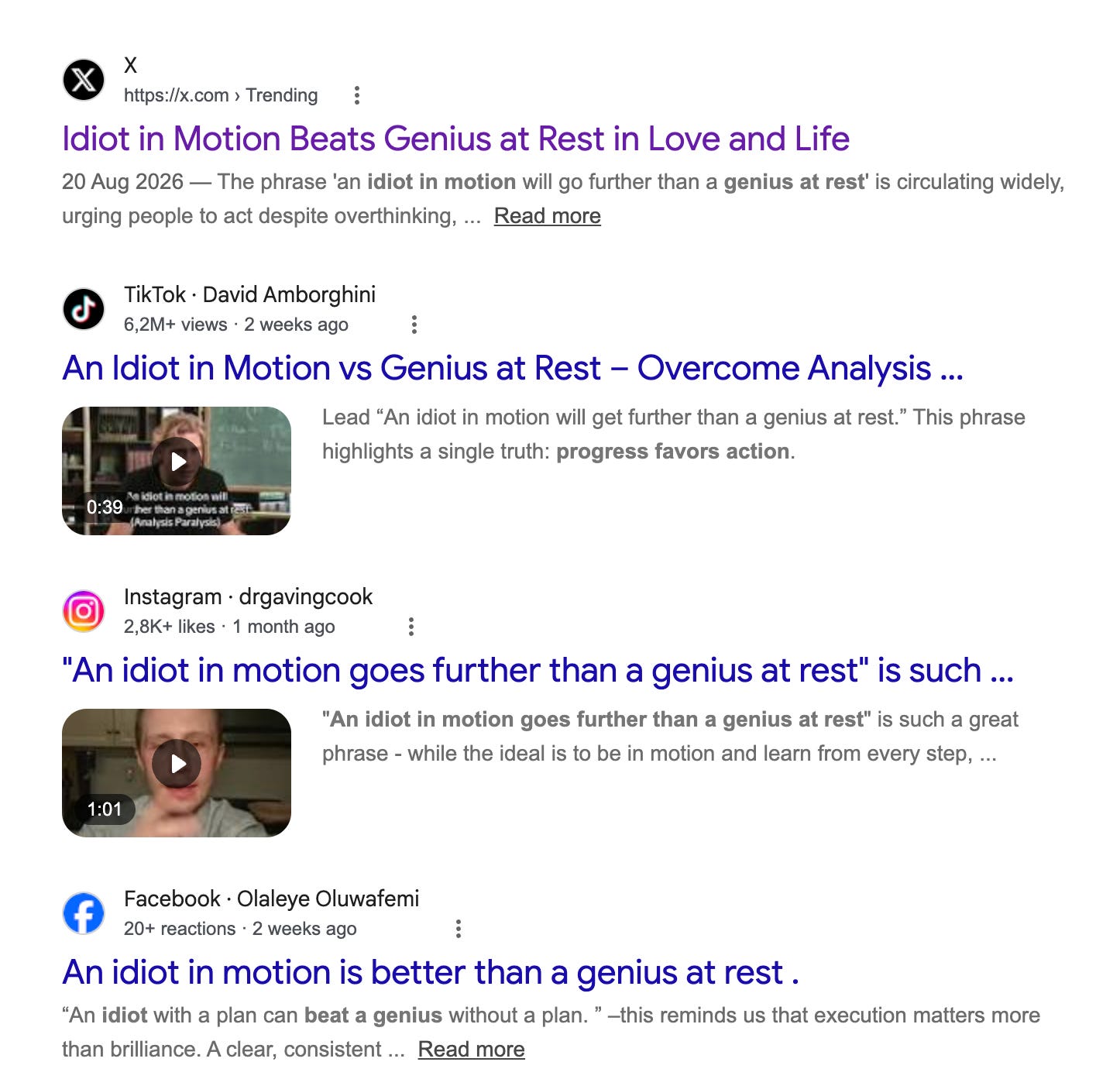
To a shocking extent, every viral tweet has basically already been tweeted out. People find a joke that works and make it over and over. One example I’ve noticed recently is “an idiot in motion beats a genius at rest.”
This even works at the individual level. One of my favorite posters, Will Manidis, has gone viral for the same tweet multiple times.

Everything is a remix. Your best idea is largely based on someone else’s? That’s ok. You can even post your own version of someone else’s best idea if it helps you. Picasso did 58 versions of Las Meninas, a painting that wasn’t even his originally. Elvis’ early music is nearly all other people’s material. The best way towards more original ideas is to become more confident in your craft and iterate your way there.
Don’t save your best ideas
The pressure to get an idea right the first time leads people to save good ideas. They save them for some imagined future where they have more time, energy, and skills to execute on it better. This future does not exist.
Saving your best stuff creates a loop that stays open. You think about it and it prevents you from thinking about other things. An unfinished idea you think about drains time and energy from other potential ideas. You need to free yourself from it by completing it.
When you have an idea and feel motivated, that is probably the most energy and motivation you are going to have towards that idea. There will always be other things trying to take away your motivation to work on it. There will always be distractions.
When building the Sagrada Familia, Gaudi knew he wasn’t going to be able to finish the entire temple during his lifetime, so he just worked on his huge Nativity facade. This way future builders would be less likely to abandon the project because such a big part of it was already done.

You never know when your career is just going to end. Fearing your first attempt should not hold you back from trying. AGI might come tomorrow and take over the entire world. Gaudi got hit by a tram one day and that was it.
No one is paying attention to your first attempt
When starting an attempt, you might imagine some big theatre where everyone is waiting for you to try and will laugh at you when you do. This is not how the world works and reality is much sadder actually.
I wrote dozens of blogs that basically no one read (and still sort of assume people don’t). This should be freeing rather than constraining. You can post your idea again and iterate freely because no one’s really paying attention.
Even if people are paying attention, they forget nearly instantly. They have consumed thousands of Reels and dozens of TV episodes and you think they’ll remember what you did? Every attempt seems like a big deal to you, but you care dramatically more about each one than anyone else will.
For example, startups launch repeatedly. Angry Birds was Rovio’s 52nd game. Twitch and Slack were famous pivots. Startups should basically always be launching (and so should you). A launch is a way to try to break through and capture attention. Assume your audience hasn’t heard what you’ve done yet.
What this ends up looking like is a lot of attempts. Do they ever end? Not really, but that is the point. The reward for good work is more work.

Great post!