If you look at the highest selling books written in the last 10 years, you’ll find they were written by bloggers. The three best examples are:
James Clear and Atomic Habits (30M+ sold)
Mark Manson and The Subtle Art of Not Giving a F*ck (20M+ sold)
Morgan Housel and Psychology of Money (10M+ sold)
As far as I can tell, the first two are #1 and #2 highest selling books published from 2016 onwards. Higher than Michelle Obama or anything you’ve seen on BookTok. Psychology of Money is ~5th for non-fiction, ~8th including fiction, but this still puts all three at the very top.
None of them were celebrities, politicians, or mainstream public intellectuals. I’m sure for some they seemed like overnight successes who got lucky. Those who followed them prior to publishing know that is not the case. They were bloggers long before they were authors.
Their success reveals the power of blogging as a medium and is relevant even if you don’t aspire to be an author. Here’s how blogging helped them succeed.
Blogging forces you to test a lot of ideas
Blog writers are prolific:
Morgan Housel wrote 3,000+ posts over 15 years across his work at The Motley Fool, Wall Street Journal, and Collaborative Fund.
Mark Manson wrote over 500 posts before he could make a living from writing. It took 8 years to build an audience to get his first traditional book deal.
James Clear published ~200 articles before he got his book deal and another ~100 before publishing.
This is a lot of reps to go through the entire ideation, writing, editing, publishing, and promotion process. Every one sharpened this entire process. They could get rapid, real feedback on how well the entire process led to traffic. Experiments with topics, titles, style, and promotion immediately became data they could use.
Compare this with how traditional authors work. They get feedback from agents and editors, but it takes a very long time to reach readers. They live in their own world for years, crafting something they hope will resonate with readers, but don’t actually know. Bloggers know.
Getting this many reps also helps bloggers narrow in on the bigger topics that resonate with readers, the ones that they eventually wrote books about.
In 2008, the most used tag for Morgan Housel on the Motley Fool blog was “investing/dividends-income.” By 2013, it was 100% “investing/general.”
Mark Manson literally blogged about pickup artistry and dating (and even wrote his first book on the subject) before moving into more general self help in 2013.
James Clear blogged about self-improvement, fitness, and even did photo essays from around the world before focusing in on habits and behavioural science by 2015-2016.
Forged by the competitiveness of the internet
You might read the word “blog” and go “yawn, people are still blogging in the year 2026?” Feel free to substitute in “writing a Substack” (but that is a lot more words).
Yes, a blog. Writing for the internet. It’s not the hot new medium, and there is a lot it is competing with. Beyond thousands of other talented writers, a blog post needs to capture your attention over delicious-looking recipe Reels, breaking news on X, the latest million dollar TV series streaming, and dozens of other media products competing for your attention.
Being able to break through this noise as a piece of writing seems like a miracle, but bloggers do it repeatedly. They are battle tested.
The book space is competitive too, people aren’t reading books anymore, but I’d argue that it’s less competitive than internet media. Once you’re convinced to buy a book, start it, and get hooked, there’s less to take you away from it. A book is an isolated and contained piece of media in a way basically nothing on the internet is. No one sits down to watch a single TikTok and doesn’t get pulled into some other distraction.
For bloggers, if you can win on the internet, you have the tools and ideas to win as a book.
Blog-style writing works as books
Writing for the internet is its own style. I’d point to Paul Graham as the peak example and definer of the style, which I’d summarize as:
Focused on novel ideas, takeaways. One key idea per post.
Real, relatable stories and examples to illustrate
Hooks, titles to bring people in.
Short paragraphs, fast pace.
Concise, lack of jargon. Shorter, simpler sentences and words.
When you look at the style of bloggers’ books, they look like this as well. The reading experience of these books is like a blog. There are plenty of takeaways, the pace is fast, people feel like they are learning a lot.
Like a good blog, this style makes these books sharable. You can apply the ideas directly to your own life. The titles, chapters, and takeaways are hooks to help you remember the ideas. You post the impact or quotes on social. You recommend the book to people. Bloggers already did all this to succeed and grow their audience, but it works just as well to sell more books.
This also contrasts them with other types of books. The writing of bloggers and their books isn’t as information-dense and filled with original research. They are not research papers or meant to enter the scientific conversation. They may take ideas from research, but they format it to be more digestible. To publish as much as they do, bloggers just can’t be doing original, ground-breaking research for every post. You can look at Malcolm Gladwell as an example of this. In a way, he is a sort of proto-blogger in his style.
Audience as marketing advantage
If you take a look at the rest of the list of biggest sellers, they nearly all have an audience of some kind. They are celebrities or public intellectuals with huge social followings who go on the biggest podcasts, make TV appearances, and have millions of people basically watching ads for their books.
Of course, bloggers have built up audiences too, and although they are smaller than most celebrities’, they might be better for selling books. Specifically, they have email lists that give them direct contact with their audience in a way few other mediums can match.
What I know from being a fan of a lot of bloggers is that they can pre-sell a lot of books in a way other personalities can’t. While others plug their book on media appearances or through Instagram, bloggers are sending dozens of emails directly to their audience. This is especially important for pre-sales as they count as first-week sales towards making it onto bestseller lists (which then drives a lot more book sales).
For example, as a long-time James Clear newsletter subscriber, I’ve seen how well he does this. Every week, I receive a valuable newsletter from him with a little sell, but I can also look back on how he did pre-sales for Atomic Habits. He did exclusive bonuses, multi-book packages, and follow-up announcements:
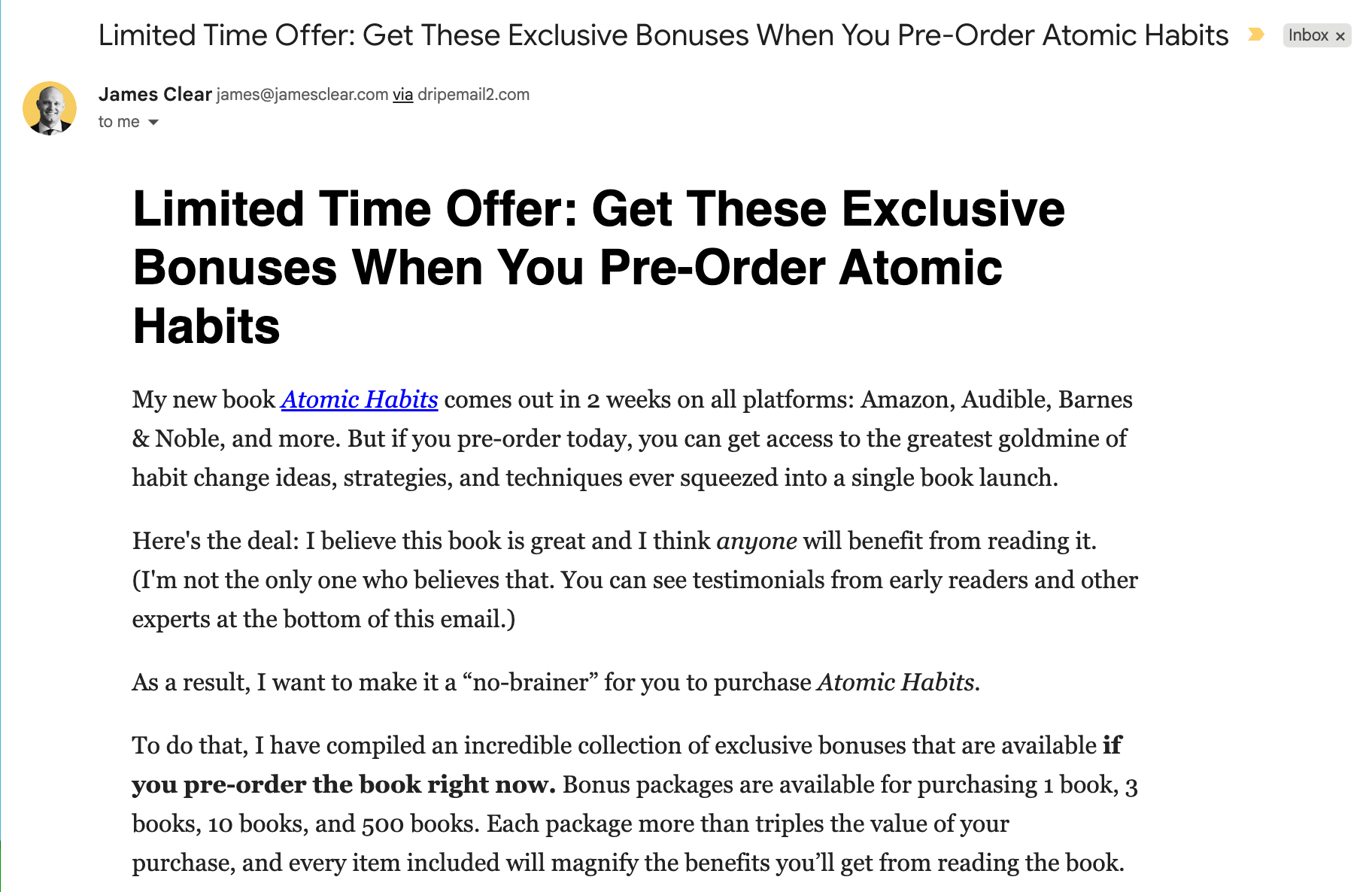
Part of blogging is marketing and marketers know that email is one of the most valuable channels. It is a captive audience that people have built billion-dollar businesses on. These authors are just the latest generation to take advantage.
A book is just a bunch of blog posts
A common critique of a book is that it “could have been a blog post.” It’s true, but I think the opposite meaning is also true: A book can be many distinct but related blog posts.
Morgan Housel’s Psychology of Money was literally a blog post first.
The Subtle Art of Not Giving a F*ck as well as many of its chapters were blog posts first.
Identity-Based Habits, the 2-Minute Rule, the Goldilocks Rule were all blogs before they were Atomic Habit chapters.
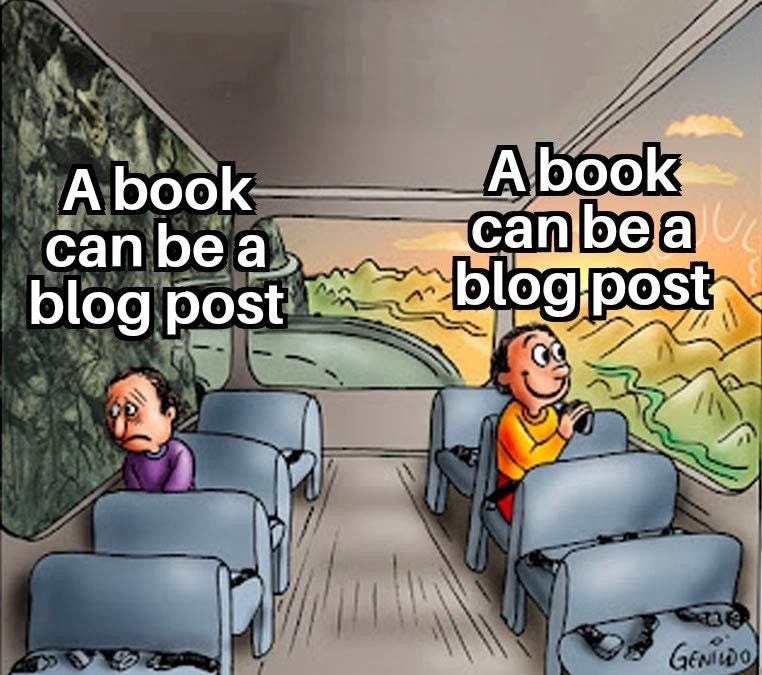
By imagining each chapter as a strong blog post, you avoid the problem books have of putting their best idea up front and filling the rest with filler. If each chapter is as good as your best blog, then that’s a lot of entertainment throughout the entire book.
This also means that if you’re writing a blog, you’re currently writing the material for your future book. Congrats, you’re in good company.
enjoyed the read and learning about this topic. well written!